Watercolour learning
When Your Watercolour Doesn’t Look Like the Tutorial
You've followed every step. So why does your painting look different?
You find a beautiful watercolour tutorial online.
The artist makes everything look effortless. The colours flow into one another, the flowers appear with a few confident brushstrokes, and the finished painting looks soft and beautiful.
You gather your paints and paper, settle in, and follow along.
But somewhere along the way, things start to look different.
Your paint spreads too far. A colour becomes darker than you intended. A flower looks a little awkward, or the background dries before you are ready.
You try to correct it, but somehow the painting becomes even further from the example.
And a thought appears:
Maybe I'm just not very good at watercolour.
If you've ever felt this way, you're not alone.
The part of a tutorial we don't always see
When we watch an experienced artist paint, we see the brush moving across the paper. We see the colours appear and gradually become a finished painting.
But there is often much more happening beneath the surface.
The artist is making decisions all the time.
Is the paper still wet enough for the colours to blend? Is the brush carrying too much water? Should the next stroke be soft and gentle, or should the paint be placed on dry paper for a clearer edge?
How much pigment is needed? When is it better to leave the painting alone?
These decisions can make a big difference to the result.
An experienced artist may make them almost automatically. A beginner, however, may not even know these are decisions to make.
That's why copying the brushstrokes alone doesn't always work.
Learning watercolour isn't just about discovering what to do. It's about understanding why you're doing it.
Watercolour behaves differently from what we expect
One of the things that makes watercolour beautiful is also what can make it challenging: water has a mind of its own.
A wet brush on damp paper can produce soft, flowing edges. The same brush on dry paper may create a much more defined mark.
A little extra water can make a colour spread across the page. Too little water can leave a stroke looking dry or uneven.
Even the paper, pigment and timing can change what happens.
When a painting doesn't turn out as expected, it doesn't necessarily mean you've failed. It may simply mean that one of these variables behaved differently from the example you were following.
And that gives you something useful to investigate.
Instead of asking, "Why can't I paint this properly?", try asking:
- Was my paper wet, damp or dry when I applied the paint?
- Did my brush hold more water than I needed?
- Was the colour too strong, or did I use too little pigment?
- What happens if I try the same stroke again with one small adjustment?
These questions turn frustration into observation.
You begin to understand the medium instead of feeling that you must somehow control every brushstroke perfectly.
Try this: one colour, three different results
You don't need to paint an entire flower to practise understanding watercolour.
Take a small piece of watercolour paper and choose one colour.
First, wet a small area of paper and allow the shine to settle a little. Touch your brush to the surface and observe how the colour moves.
Next, try applying the same colour to dry paper. Notice how the edge looks different.
Finally, use a brush with less water and make a short stroke. Compare the result with your first two attempts.
Don't worry about making three beautiful marks.
Instead, notice what changes.
You are beginning to build a mental library of experiences: what happens when the paper is wet, what happens when it is dry, and how the amount of water changes the result.
That knowledge will gradually help you make more confident decisions when you paint something of your own.
You can learn without getting everything right
I love sharing finished paintings, but I also believe the learning process deserves attention.
The unexpected edges, the colours that turn out differently, and the moments when you need to pause and try again are all part of becoming familiar with watercolour.
You don't need to master every technique before you can enjoy painting.
And you don't have to depend on following someone else's brushstrokes forever.
With practice, you can begin to understand why a technique works, adapt it to your own painting, and make decisions with greater confidence.
That's the kind of learning I want to encourage here at ZenBeautifulArt: calm, structured, practical, and full of room to experiment.
Let's make your next painting a little easier
If you're feeling overwhelmed by all the techniques, materials and advice available online, you don't need to learn everything at once.
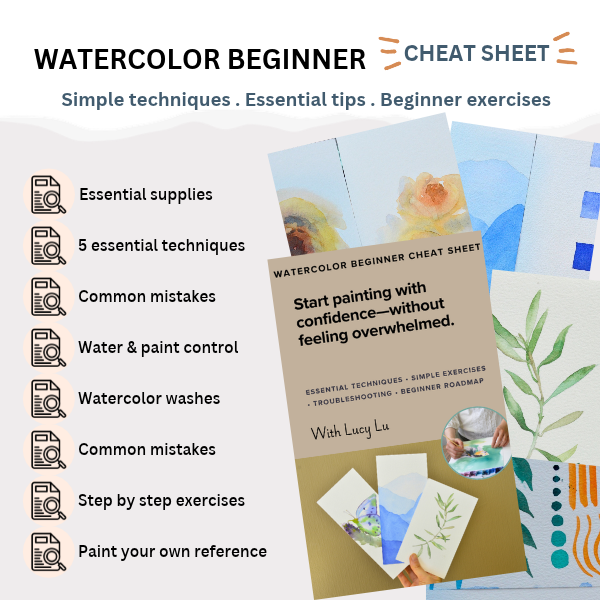
I've created a free Watercolor Beginner Cheat Sheet to help you get started with the essentials, practise basic techniques, and take your first steps with a little more confidence.
Get the Watercolor Beginner Cheat Sheet →
And if you've ever struggled to follow a watercolour tutorial, I'd love to hear about it.
What is the one thing you find hardest when painting — controlling water, mixing colours, choosing the right brushstroke, or knowing what to do next?
Your questions help me understand what would make learning easier for you, and they may inspire future tutorials, too.
— Lucy | ZenBeautifulArt
← Back to the blog